water tank disinfection services Bangalore
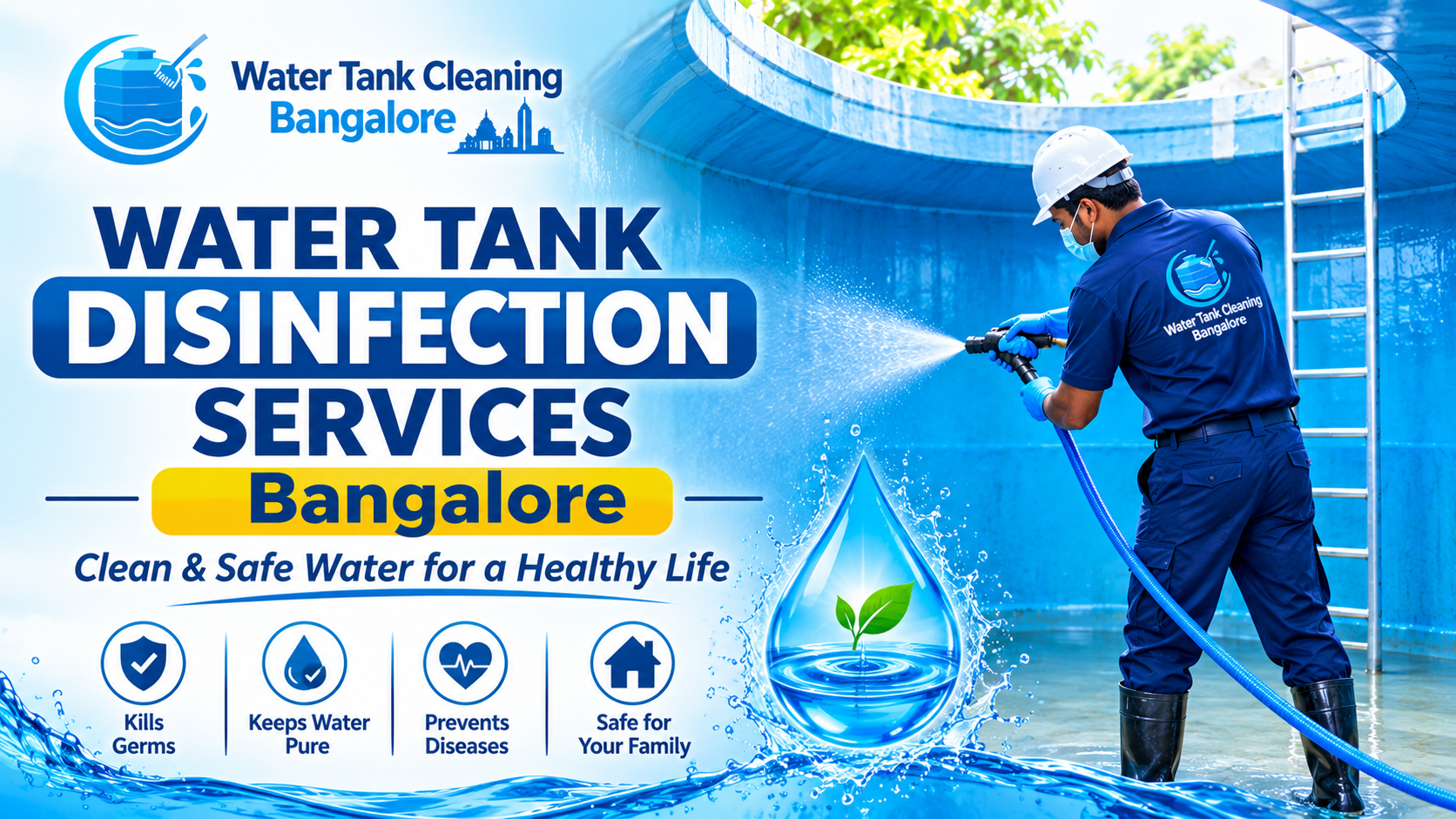
Water Tank Disinfection Services Bangalore: Professional Sanitisation for Cleaner and Hygienic Water Storage
Clean water is essential for maintaining a healthy home, workplace and community. Every day, households, apartments, offices, hospitals, schools and commercial establishments depend on stored water for drinking, cooking, bathing, cleaning and other essential activities. However, maintaining clean water is not only about the quality of the incoming supply. The condition of the tank in which water is stored is equally important.
Over time, water storage tanks can accumulate mud, sand, dust, algae, organic deposits and biofilm. These contaminants may create conditions that support microbial growth and affect the hygiene of stored water. Even when water appears clear, the internal surfaces of an improperly maintained tank may contain unwanted deposits.
This is why professional water tank disinfection services in Bangalore are an important part of regular water storage maintenance.
Water tank disinfection involves treating cleaned internal surfaces using suitable disinfectants and appropriate procedures to reduce microbial contamination. It is most effective when combined with proper sludge removal, scrubbing, pressure cleaning and thorough rinsing.
At Water Tank Cleaning Bangalore, we provide professional water tank cleaning and disinfection services for residential properties, villas, apartments, housing societies, offices, hospitals, educational institutions and commercial facilities.
Our cleaning approach includes inspection, controlled drainage, sediment removal, internal surface cleaning, rinsing and appropriate disinfection. We focus on maintaining hygienic water storage conditions through systematic cleaning procedures and suitable equipment.
Whether you need disinfection for a small residential overhead tank or a large underground sump serving an apartment complex, professional maintenance helps protect the hygiene of your water storage system.
What Are Water Tank Disinfection Services?
Water tank disinfection is a cleaning and sanitisation procedure designed to reduce harmful microorganisms on the internal surfaces of water storage tanks.
Water tanks may become contaminated through incoming water, damaged covers, environmental exposure, accumulated sediment and poorly maintained plumbing connections.
Disinfection is intended to reduce microbial contamination after physical cleaning has removed dirt and other deposits.
A comprehensive water tank cleaning and disinfection service generally includes:
-
Initial tank inspection.
-
Controlled drainage of stored water.
-
Removal of accumulated sludge and sediment.
-
Scrubbing of internal walls and floors.
-
Cleaning of corners and difficult-to-reach areas.
-
High-pressure washing where appropriate.
-
Removal of loosened dirt and waste.
-
Thorough rinsing.
-
Application of a suitable disinfectant.
-
Final inspection before the tank is returned to service.
The disinfection method must be selected according to the tank material, intended water use and contamination level.
For tanks storing water intended for human consumption, only products and procedures suitable for potable-water applications should be used.
It is also important to understand that cleaning and disinfection do not automatically certify water as safe to drink. Where contamination is suspected, appropriate water quality testing is recommended.
Why Is Water Tank Disinfection Important in Bangalore?
Bangalore properties receive water through different sources, including municipal supply, borewells and private water tankers.
The quality of incoming water can vary depending on its source, distribution conditions, storage and handling.
When water enters a storage tank, small quantities of sediment and other particles may settle at the bottom. Organic material and microorganisms may also accumulate on internal surfaces if the tank is not maintained properly.
Several factors make regular water storage maintenance important.
1. Different Water Supply Sources
Residential and commercial properties in Bangalore may use multiple water sources.
For example, an apartment complex may receive municipal water and tanker water, while an independent house may depend on borewell water.
Each source may have different characteristics and sediment levels.
Regular tank inspection and cleaning help address deposits that enter through these supply connections.
2. Dust and Environmental Contamination
Tanks located on rooftops or exposed outdoor areas may be affected by dust, insects and environmental debris.
Damaged or poorly fitted covers can allow contaminants to enter the storage system.
These materials may settle inside the tank and contribute to contamination.
3. Algae and Biofilm Formation
Algae can develop when suitable light, moisture and nutrient conditions are present.
Biofilm is a layer of microorganisms that can attach to wet internal surfaces.
These deposits may remain on tank walls, floors and corners even after the stored water is drained.
Physical cleaning followed by suitable disinfection is important for addressing this type of contamination.
4. Irregular Cleaning
Many property owners arrange tank cleaning only after noticing an unusual smell, visible particles or changes in water appearance.
However, microbial contamination is not always visible.
Regular cleaning and disinfection help maintain better storage hygiene rather than waiting for obvious warning signs.
5. Shared Water Storage Systems
Apartments, commercial buildings, schools and hospitals often depend on large storage systems that serve many people.
These systems require planned maintenance because contamination in a shared storage tank may affect multiple outlets and users.
Professional water tank disinfection helps facility managers maintain a structured water hygiene programme.
Signs Your Water Tank Needs Professional Disinfection
Water tank contamination is not always easy to identify from outside.
However, certain warning signs indicate that the storage system should be inspected and cleaned.
1. Unusual Smell in Stored Water
If water develops an unpleasant or unusual smell, the tank and incoming supply should be inspected.
Organic deposits, microbial activity and contamination may contribute to odour problems.
Disinfection alone may not solve the issue if the source of contamination remains.
2. Cloudy or Discoloured Water
Water that appears brown, yellowish, cloudy or unusually discoloured may indicate sediment, rust or other impurities.
The cause may originate from the water source, pipelines or storage tank.
A proper inspection helps identify the source before selecting a cleaning procedure.
3. Green Deposits Inside the Tank
Green patches or slimy deposits on internal tank surfaces may indicate algae or biofilm formation.
These deposits should be physically removed as part of a complete cleaning procedure.
4. Visible Mud and Sludge
Mud, sand and sediment can collect at the bottom of tanks.
These deposits may contain organic material and provide conditions that support microbial growth.
Sludge extraction should therefore be completed before the disinfection stage.
5. Insects or Organic Debris
Dead insects, leaves and other debris may enter tanks through damaged covers and openings.
Such contamination should be removed promptly, followed by an appropriate cleaning and disinfection procedure.
6. Long Periods Without Maintenance
Even when water appears normal, an uncleaned tank may contain accumulated sediment and attached deposits.
If your tank has not been inspected or cleaned for a long period, arranging professional maintenance is advisable.
7. Recurring Water Quality Concerns
If water quality problems continue after cleaning, investigate the incoming water source, plumbing connections and distribution system.
Water testing may be necessary to determine whether microbial or chemical contamination is present.
Difference Between Water Tank Cleaning and Water Tank Disinfection
Water tank cleaning and water tank disinfection are related activities, but they serve different purposes.
Understanding the difference helps property owners choose the correct service.
What Is Water Tank Cleaning?
Water tank cleaning focuses on physically removing visible dirt and accumulated deposits.
It generally includes:
-
Removing stored water.
-
Extracting mud and sludge.
-
Scrubbing internal walls.
-
Removing algae and attached deposits.
-
Pressure washing where appropriate.
-
Rinsing the tank.
The objective is to remove physical contaminants from the storage system.
What Is Water Tank Disinfection?
Water tank disinfection is a treatment procedure intended to reduce microorganisms on cleaned surfaces.
It involves applying an appropriate disinfectant according to the recommended concentration, contact time and application instructions.
The tank may require further rinsing or flushing before it is returned to service, depending on the product and procedure.
Why Both Processes Matter
Applying disinfectant over thick sludge and dirty surfaces may not provide effective treatment because organic material and biofilm can interfere with disinfection.
Therefore, physical cleaning should generally take place before disinfection.
| Activity | Tank cleaning | Tank disinfection |
|---|---|---|
| Removing mud | Yes | No |
| Extracting sludge | Yes | No |
| Scrubbing tank walls | Yes | No |
| Removing visible algae | Yes | No |
| Reducing microorganisms | Not the primary purpose | Yes |
| Chemical treatment | Not always | Yes |
| Rinsing | Yes | As required by procedure |
For effective water storage maintenance, both activities should be considered as part of a complete service.
Our Professional Water Tank Disinfection Process in Bangalore
At Water Tank Cleaning Bangalore, our approach combines physical cleaning with appropriate disinfection.
The exact procedure depends on tank size, construction, contamination level and intended water use.
Step 1: Initial Tank Inspection
The process begins with an inspection of the water storage system.
Our technicians assess:
-
Tank capacity.
-
Tank construction and material.
-
Overhead or underground location.
-
Visible sludge accumulation.
-
Algae and surface deposits.
-
Water condition and unusual odours.
-
Access points and ventilation.
-
Equipment and safety requirements.
This assessment helps determine the appropriate cleaning and disinfection procedure.
For underground tanks, access and confined-space safety requirements must be assessed before any entry is considered.
Step 2: Controlled Water Drainage
The stored water is drained using suitable equipment.
Removing the stored water exposes the tank floor and internal surfaces for cleaning.
The drainage process is planned according to the property's water requirements.
For apartments and commercial establishments, the work can be coordinated with facility management to minimise unnecessary interruption.
Step 3: Sludge and Sediment Removal
Mud, sand, silt and other accumulated deposits are removed from the tank floor.
Depending on the contamination level, technicians may use suitable manual or mechanical extraction methods.
Common deposits include:
-
Mud and soil.
-
Sand and silt.
-
Rust particles.
-
Dead algae.
-
Organic debris.
-
Other accumulated sediment.
This stage is important because disinfection should not be treated as a substitute for physical cleaning.
Step 4: Internal Surface Scrubbing
Once the sludge is removed, the internal walls, floor and corners are scrubbed.
Tank surfaces may contain attached dirt, algae and biofilm that cannot be eliminated through drainage alone.
Suitable brushes and cleaning tools are selected according to the tank material.
Care is taken to avoid damaging plastic surfaces, protective coatings or waterproofing layers.
Step 5: High-Pressure Jet Cleaning
High-pressure water jet cleaning helps loosen stubborn deposits from internal surfaces.
This method can be useful for larger underground sumps and overhead tanks with extensive sediment or algae buildup.
Pressure settings are selected according to the tank construction and surface condition.
The aim is to remove deposits without damaging the storage structure.
Step 6: Vacuum Extraction and Waste Removal
Where required, vacuum extraction equipment is used to remove loosened sludge, slurry and residual cleaning waste.
This helps clean difficult-to-reach sections and reduces the possibility of leftover deposits remaining at the bottom.
Collected waste should be handled and disposed of appropriately.
Step 7: Appropriate Water Tank Disinfection
After physical cleaning and rinsing, a suitable disinfectant is applied according to the product instructions and the intended water use.
The treatment should consider:
-
Disinfectant suitability.
-
Correct concentration.
-
Contact time.
-
Tank material compatibility.
-
Water quality requirements.
-
Necessary rinsing or flushing.
For potable-water storage systems, the disinfectant and procedure must be suitable for drinking-water applications.
Disinfectants should never be mixed with other cleaning chemicals.
Step 8: Final Rinsing and Inspection
After disinfection, the tank is rinsed or flushed as required by the selected treatment procedure.
Technicians inspect the internal surfaces for remaining visible deposits and cleaning residue.
The tank can then be returned to service according to the agreed procedure.
Where drinking-water contamination is suspected, appropriate laboratory testing should be considered before the water is used for consumption.
Overhead Water Tank Disinfection Services Bangalore
Overhead tanks are widely used in independent houses, villas, apartments and commercial properties.
They store water that is distributed to kitchens, bathrooms and other outlets through gravity or pumping systems.
Although overhead tanks may appear protected, their internal surfaces can still accumulate contaminants.
Common Contamination Problems in Overhead Tanks
Some common issues include:
-
Dust entering through damaged covers.
-
Algae growth on internal surfaces.
-
Sediment entering through supply connections.
-
Dead insects and organic debris.
-
Rust particles from plumbing connections.
-
Biofilm accumulation.
-
Irregular cleaning.
Why Overhead Tank Disinfection Is Important
Overhead tanks supply water directly to multiple outlets throughout a building.
If the tank is poorly maintained, contamination inside it may affect the water distributed through the connected plumbing system.
Professional cleaning and disinfection help maintain better storage hygiene.
Our Overhead Tank Disinfection Approach
Our cleaning procedure may include controlled drainage, sludge removal, internal scrubbing, suitable pressure washing, rinsing and disinfection.
Technicians also consider rooftop access, working height, slippery surfaces and electrical equipment during the cleaning process.
Whether you have a small plastic tank or a larger rooftop storage system, the cleaning method should match the tank material and condition.
Underground Water Tank Disinfection Services Bangalore
Underground water tanks, also known as sumps, are common in Bangalore residential and commercial properties.
They usually receive incoming water and store it before transferring it to overhead tanks.
Because underground sumps receive water directly from external supply connections, they may accumulate mud, sand, silt and other impurities.
Common Problems in Underground Water Tanks
Underground tanks may experience:
-
Heavy sediment accumulation.
-
Mud and sand deposits.
-
Algae and biofilm formation.
-
Organic contamination.
-
Unpleasant odours.
-
Poorly maintained internal surfaces.
-
Contamination through damaged access covers.
Why Underground Tank Disinfection Requires Professional Attention
Underground tanks can present serious confined-space hazards.
Restricted entry, inadequate ventilation and potentially unsafe atmospheric conditions make these tanks particularly challenging to clean.
Entry should only be considered after a suitable risk assessment, atmospheric monitoring where necessary, trained personnel, appropriate equipment and emergency rescue arrangements.
Where possible, cleaning should use methods that avoid unnecessary human entry.
Professional Sump Cleaning and Disinfection
The cleaning procedure may include:
-
Site inspection and safety assessment.
-
Controlled drainage.
-
Sludge and sediment extraction.
-
Internal surface cleaning.
-
High-pressure washing where suitable.
-
Waste removal.
-
Appropriate disinfection.
-
Final rinsing and inspection.
Regular sump maintenance helps maintain a cleaner storage environment and supports the overall hygiene of the building's water distribution system.
Apartment and Housing Society Water Tank Disinfection
Apartment communities in Bangalore often depend on several underground sumps and overhead tanks to supply water to residents.
These shared storage systems require systematic cleaning and disinfection because they serve multiple households.
A maintenance issue in one storage tank may affect the water supply to several apartments.
Why Apartment Water Tanks Need Regular Disinfection
Apartment tanks may accumulate contaminants due to:
-
Different incoming water sources.
-
Repeated filling and emptying cycles.
-
Sediment accumulation.
-
Environmental exposure.
-
Algae and biofilm.
-
Inadequate cleaning schedules.
Regular maintenance helps property management teams identify and address these problems.
Our Apartment Tank Disinfection Services
Water Tank Cleaning Bangalore provides cleaning support for apartment associations, gated communities and housing societies.
Our approach considers:
Multiple tank inspection: Identifying the tanks that require cleaning and disinfection.
Scheduled drainage: Coordinating water removal according to the building's supply requirements.
Sludge extraction: Removing accumulated sediment and organic deposits.
Surface cleaning: Scrubbing and cleaning internal walls and floors.
Disinfection: Applying suitable disinfectants according to the tank's intended use.
Final inspection: Checking the tank before returning it to service.
For larger communities, planned cleaning schedules help facility managers coordinate maintenance with minimal inconvenience to residents.
Residential Water Tank Disinfection Services
Every household depends on stored water for daily activities.
Residential water tanks may include underground sumps, overhead plastic tanks and smaller storage units.
When these tanks are not cleaned regularly, dirt and sediment may accumulate.
Why Homeowners Should Arrange Tank Disinfection
Professional residential tank disinfection helps address microbial contamination following physical cleaning.
It is particularly relevant when:
-
The tank has not been cleaned for an extended period.
-
Algae or biofilm is visible.
-
Water has developed an unusual smell.
-
The tank has been exposed to external contamination.
-
Cleaning is required after maintenance or repairs.
-
A water quality concern has been identified.
Our Residential Cleaning Approach
Our residential cleaning service is designed around the size and condition of the storage system.
The procedure may include drainage, sludge extraction, scrubbing, rinsing and appropriate disinfection.
We aim to make the process convenient while maintaining suitable hygiene and safety practices.
Commercial Water Tank Disinfection Services Bangalore
Commercial properties depend on water storage systems for daily operations.
Offices, hotels, restaurants, shopping complexes and business establishments may have multiple tanks serving employees, customers and operational requirements.
Maintaining these systems is important for building hygiene and facility management.
Common Commercial Water Tank Problems
Commercial tanks may develop:
-
Sediment accumulation.
-
Algae and biofilm.
-
Organic deposits.
-
Rust particles.
-
Unpleasant odours.
-
Microbial contamination.
The risk and cleaning requirements depend on the water source, tank construction and intended application.
Professional Commercial Tank Disinfection
Our commercial tank cleaning approach combines physical cleaning and suitable disinfection.
The work can be planned according to the number of tanks, storage capacity, operational schedule and site accessibility.
We support cleaning enquiries from offices, hotels, business parks and other commercial establishments across Bangalore.
Hospital and School Water Tank Disinfection
Hospitals and educational institutions require careful water storage maintenance because their facilities serve large numbers of people.
A structured cleaning and disinfection programme supports their overall hygiene management.
Hospital Water Tank Disinfection
Hospitals use water for sanitation, housekeeping and various facility operations.
Different storage tanks may serve different applications.
Cleaning and disinfection schedules should be coordinated with hospital facility teams according to water usage, hygiene requirements and risk assessments.
Where tanks supply water for specialised clinical or medical purposes, the relevant technical and regulatory requirements must also be considered.
School and College Water Tank Disinfection
Schools and colleges depend on stored water for washrooms, kitchens, drinking-water stations and general cleaning.
Periodic tank maintenance helps address accumulated sediment and microbial contamination.
A suitable cleaning schedule, appropriate disinfection and secure tank covers support better water storage hygiene.
Industrial Water Tank Disinfection Services
Industrial facilities may operate large-capacity water storage systems that support manufacturing, housekeeping, cooling and other operations.
These tanks can require specialised cleaning methods depending on their contents and previous use.
Common Industrial Storage Systems
Industrial facilities may have:
-
Raw water storage tanks.
-
Process water tanks.
-
Underground reservoirs.
-
Overhead storage tanks.
-
Cooling water storage systems.
-
Utility water tanks.
Not every industrial tank is intended to store potable water.
Therefore, the cleaning and disinfection method must be selected according to the tank's purpose and material compatibility.
Professional Industrial Tank Cleaning and Disinfection
Our industrial cleaning enquiries are assessed according to tank capacity, contamination type, accessibility and site-specific safety requirements.
Where hazardous residues or specialised industrial chemicals may be present, a suitable specialist procedure and waste-handling plan are necessary.
The objective is to maintain the required hygiene condition without compromising the tank structure or operational requirements.
Benefits of Professional Water Tank Disinfection
Regular professional disinfection, when performed after proper physical cleaning, offers several practical benefits.
1. Helps Reduce Microbial Contamination
Suitable disinfection can reduce microorganisms present on cleaned tank surfaces.
This is important for maintaining hygienic water storage conditions.
2. Addresses Contamination After Physical Cleaning
Sludge removal and scrubbing eliminate physical deposits.
Disinfection provides an additional treatment step intended to reduce remaining microbial contamination.
3. Supports Better Water Storage Hygiene
A clean and properly disinfected tank provides a better-maintained environment for storing water.
4. Helps Address Biofilm-Related Contamination
Biofilm can attach to tank walls and other wet surfaces.
Physical removal followed by suitable disinfection helps address this problem more effectively than simply draining and refilling the tank.
5. Helps Reduce Unpleasant Odours
Organic deposits and microbial activity may contribute to unpleasant smells.
Cleaning and disinfection can help address these sources, although the incoming supply should also be checked if odour problems continue.
6. Supports Apartment and Commercial Facility Maintenance
Scheduled disinfection helps facility managers maintain consistent cleaning records and plan water storage maintenance.
7. Encourages Preventive Maintenance
Regular inspection helps identify damaged covers, sediment accumulation and other problems before they become more difficult to address.
8. Improves Confidence in Tank Hygiene
A documented cleaning and disinfection procedure helps property owners understand how their water storage systems are maintained.
However, disinfection alone cannot guarantee that water is safe for drinking. Water quality testing is the appropriate way to verify its condition.
How Often Should Water Tanks Be Disinfected in Bangalore?
The ideal frequency depends on the type of property, water source, tank condition, usage and contamination risk.
For many residential properties, a cleaning and disinfection interval of approximately three to six months can be used as a general maintenance starting point.
Properties with high usage or frequent sediment accumulation may require more frequent cleaning.
The following table provides a general maintenance guide.
| Property type | Suggested maintenance interval |
|---|---|
| Independent houses | Every 3–6 months |
| Villas | Every 3–6 months |
| Apartments | Every 3–4 months |
| Housing societies | Every 3–4 months |
| Commercial buildings | Every 3–6 months |
| Schools and colleges | Based on usage and hygiene assessment |
| Hospitals | According to facility hygiene protocols |
| Industrial facilities | Based on tank application and risk assessment |
These are general planning intervals, not universal legal requirements.
Disinfection should also be arranged when contamination is suspected, after certain repairs or when the tank has been exposed to external contaminants.
Why Regular Maintenance Matters in Bangalore
Bangalore properties may use different combinations of municipal supply, borewell water and tanker water.
Changes in supply conditions can introduce additional sediment and impurities.
Regular inspections help property owners identify these issues and adjust their cleaning schedules accordingly.
DIY Water Tank Disinfection vs Professional Services
Some property owners attempt to disinfect tanks using household cleaning products.
However, water storage tanks require a controlled procedure, particularly when they supply water intended for drinking or cooking.
Problems With DIY Disinfection
1. Incorrect chemical concentration
Using too much disinfectant can leave unwanted residues, while insufficient concentration may result in ineffective treatment.
2. Incomplete physical cleaning
Disinfectants may be less effective when thick sludge and organic deposits remain on internal surfaces.
3. Incorrect contact time
Different products have specific application and contact-time requirements.
4. Unsafe chemical mixing
Mixing cleaning products can produce dangerous reactions and harmful fumes.
5. Limited equipment
Household tools may not be suitable for removing heavy sediment and biofilm.
6. Safety risks
Underground tank entry and rooftop cleaning require appropriate precautions.
Advantages of Professional Tank Disinfection
Professional service providers can use suitable equipment and follow a structured cleaning procedure.
Depending on the tank requirements, this may include:
-
Drainage pumps.
-
Sludge extraction equipment.
-
Internal scrubbing tools.
-
High-pressure jet machines.
-
Vacuum extraction equipment.
-
Appropriate disinfectants.
-
Personal protective equipment.
-
Final inspection procedures.
Professional cleaning is particularly useful for apartment complexes, large underground sumps and commercial water storage systems.
How to Choose the Best Water Tank Disinfection Company in Bangalore
Selecting the right service provider is important because the quality of the procedure directly affects the condition of the water storage system.
Here are some important factors to consider.
1. Check the Complete Cleaning Procedure
Ask whether the service includes sludge removal, scrubbing, rinsing and disinfection.
A service that only applies disinfectant without removing accumulated dirt may not address the underlying problem.
2. Understand the Disinfectant Used
Ask which product is used and whether it is suitable for the intended water storage application.
For potable-water tanks, product suitability and application instructions are particularly important.
3. Check Equipment Availability
Professional services may require drainage pumps, pressure washers, vacuum equipment and appropriate cleaning tools.
The equipment should be suitable for the tank material and capacity.
4. Verify Technician Safety Practices
Ask how the company manages rooftop work and underground tank cleaning.
Confined-space entry should never be treated as ordinary cleaning work. Appropriate risk assessment, atmospheric monitoring, trained personnel and emergency arrangements are essential.
5. Confirm Experience With Different Tank Types
Choose a provider that understands the cleaning requirements of overhead tanks, underground sumps, apartment reservoirs and commercial storage systems.
6. Understand the Quotation
A professional quotation should clearly explain the scope of work.
The price may depend on:
-
Tank capacity.
-
Tank material.
-
Sludge accumulation.
-
Access conditions.
-
Number of tanks.
-
Cleaning requirements.
-
Disinfection procedure.
7. Ask About Final Inspection
A final inspection helps confirm that visible deposits and cleaning residues have been addressed before the tank is returned to service.
Water Tank Disinfection Services Across Bangalore
Water Tank Cleaning Bangalore provides professional tank cleaning and disinfection services for residential and commercial properties across Bangalore.
Our service enquiries cover several important localities.
East Bangalore
-
Whitefield.
-
Marathahalli.
-
Bellandur.
-
KR Puram.
-
Hegde Nagar.
-
Electronic City.
North Bangalore
-
Hebbal.
-
Yelahanka.
-
RT Nagar.
-
Jalahalli.
-
Nearby residential layouts.
South Bangalore
-
JP Nagar.
-
BTM Layout.
-
Electronic City.
-
Surrounding residential areas.
West and Central Bangalore
-
Rajajinagar.
-
Established residential neighbourhoods.
-
Commercial buildings and business premises.
Service availability depends on the location, tank requirements and technician schedule.
Whether you require disinfection for a single household tank or multiple storage systems in a large apartment community, contact our team to discuss the work.
Factors Affecting Water Tank Disinfection Cost in Bangalore
The cost of professional water tank disinfection depends on several factors.
There is no single price suitable for every property because different tanks require different equipment, labour and cleaning procedures.
1. Tank Capacity
Larger tanks require more time and resources for cleaning and treatment.
2. Tank Type
Overhead tanks, underground sumps and large commercial reservoirs have different access and cleaning requirements.
3. Contamination Level
A tank with light sediment requires less physical cleaning than one containing heavy sludge, algae and biofilm.
4. Accessibility
Difficult rooftop access, narrow openings and underground entry requirements may affect the overall work.
5. Number of Tanks
Apartment associations and commercial facilities may have several tanks that can be scheduled together.
6. Disinfection Requirements
The selected disinfectant, treatment method and application procedure may influence the service quotation.
7. Additional Cleaning Work
Sludge extraction, pressure washing, vacuum cleaning and additional rinsing may affect the final price.
At Water Tank Cleaning Bangalore, customers can share their tank specifications and location to receive a quotation based on the actual requirements.
How to Maintain Tank Hygiene After Disinfection
Disinfection is not a permanent solution if the tank continues to receive contaminants.
Property owners should follow basic preventive maintenance practices after professional cleaning.
1. Keep Tank Covers Secure
A properly fitted cover helps prevent dust, insects, leaves and other external debris from entering.
2. Inspect the Water Inlet
Check whether incoming water contains visible sediment.
If the supply is repeatedly contaminated, investigate the source and consider suitable filtration or other treatment.
3. Monitor Water Appearance and Smell
Pay attention to unusual changes in water colour, clarity and odour.
Investigate recurring problems rather than relying only on repeated disinfection.
4. Inspect Internal Surfaces Periodically
Regular inspection helps identify algae, sediment, cracks and other maintenance issues.
5. Maintain Cleaning Records
Record the cleaning date, tank condition, disinfection method and next scheduled inspection.
This is particularly important for apartment associations and commercial properties.
6. Maintain Connected Pipelines
Inspect connected plumbing, valves and inlet connections.
Contamination can originate outside the tank, so maintaining the complete distribution system is important.
7. Avoid Unapproved Chemicals
Never use household cleaning chemicals without checking their suitability for the intended water storage application.
Never mix bleach with acids, ammonia or other cleaning products.
8. Arrange Water Quality Testing When Necessary
If there is a suspected contamination event, arrange suitable water testing.
For drinking-water applications, testing should be conducted using appropriate methods and recognised laboratory procedures.
Why Choose Water Tank Cleaning Bangalore for Disinfection Services?
Maintaining clean water storage requires a systematic cleaning procedure and suitable disinfection practices.
At Water Tank Cleaning Bangalore, we provide tank cleaning solutions for different residential and commercial requirements.
Experienced Cleaning Team
Our technicians handle cleaning requirements for different types of water storage systems.
Professional Cleaning Equipment
We use suitable cleaning equipment, including high-pressure jet machines and vacuum extraction where required.
Hygienic Cleaning Process
Our approach includes sludge removal, internal scrubbing, rinsing and appropriate disinfection.
Residential and Commercial Coverage
We accept service enquiries for independent houses, villas, apartments, offices, hospitals, schools and commercial facilities.
Suitable Disinfection Products
Our service approach considers the intended water use and the suitability of cleaning and disinfection products.
Safety-Focused Work
We consider access, equipment and site-specific safety requirements when planning tank cleaning work.
Transparent Pricing
The quotation is based on tank capacity, condition, accessibility and the cleaning procedure required.
Bangalore Service Availability
We support customers across several Bangalore localities, with scheduling based on service availability.
Same-Day Service Availability
Same-day service may be available depending on location, technician availability and the scope of work.
Our objective is to provide systematic tank cleaning and disinfection that supports better water storage hygiene.
Frequently Asked Questions About Water Tank Disinfection Services Bangalore
1. What are water tank disinfection services?
Water tank disinfection services involve treating cleaned internal tank surfaces using suitable disinfectants to reduce microbial contamination. The process is generally carried out after sludge removal, scrubbing and rinsing.
2. Why is water tank disinfection necessary?
Disinfection helps reduce microorganisms that may remain on tank surfaces after physical cleaning. It supports better water storage hygiene when performed using appropriate products and procedures.
3. How often should a water tank be disinfected in Bangalore?
For many residential properties, cleaning and disinfection every three to six months is a practical starting point. The frequency depends on the water source, contamination level, tank condition and usage.
4. What is the difference between cleaning and disinfection?
Cleaning physically removes dirt, mud, sludge, algae and other deposits. Disinfection uses an appropriate treatment to reduce microorganisms. Both activities serve different purposes and are often included in a complete tank maintenance service.
5. Can water tank disinfection remove bacteria?
Appropriate disinfection can reduce bacteria and other susceptible microorganisms when the correct product, concentration and contact time are used. However, it does not guarantee that all contamination has been eliminated.
6. Is water tank disinfection safe for drinking-water tanks?
Yes, provided the disinfectant and procedure are suitable for potable-water storage systems. Product instructions, contact time and any required rinsing or flushing must be followed carefully.
7. What chemicals are used for water tank disinfection?
Suitable disinfectants may include chlorine-based products and other approved treatments intended for water storage applications. The selection depends on the tank and intended use. Products should never be mixed without explicit manufacturer guidance.
8. Should the tank be emptied before disinfection?
For comprehensive cleaning and surface disinfection, the tank generally needs to be drained sufficiently to expose the internal surfaces. The exact procedure depends on the tank design and treatment method.
9. Can overhead water tanks be disinfected?
Yes. Overhead tanks can be cleaned and disinfected using suitable methods. The procedure includes physical cleaning, rinsing and appropriate disinfection, with attention to rooftop access and worker safety.
10. Do underground sumps require disinfection?
Yes. Underground sumps can accumulate sediment, organic deposits and microbial contamination. Professional cleaning and disinfection help maintain their hygiene.
11. Does disinfection remove algae?
Disinfection alone may not remove established algae deposits. Physical scrubbing and appropriate cleaning should first remove visible algae and biofilm, followed by suitable disinfection.
12. Can apartment water tanks be disinfected together?
Yes. Multiple overhead tanks and underground sumps in an apartment complex can be scheduled for coordinated cleaning and disinfection. The schedule depends on tank capacity, access and water supply requirements.
13. How long does water tank disinfection take?
The time depends on tank size, contamination level, accessibility and the selected cleaning and disinfection procedure. Small residential tanks generally require less time than large underground or commercial tanks.
14. Does water tank disinfection improve water quality?
It can improve the hygienic condition of the storage system by reducing microbial contamination. However, overall water quality also depends on the incoming supply and plumbing. Testing is recommended when drinking-water safety is uncertain.
15. Is disinfection required after every tank cleaning?
The need for disinfection depends on the intended water use, contamination level and maintenance requirements. For potable-water storage, appropriate disinfection is an important part of a comprehensive cleaning programme.
16. Can I disinfect my water tank myself?
Small maintenance tasks may be handled by property owners, but complete cleaning and disinfection require suitable products, correct concentrations, appropriate equipment and safety precautions. Professional service is advisable for larger and underground tanks.
17. Do you provide commercial water tank disinfection in Bangalore?
Yes. Water Tank Cleaning Bangalore accepts service enquiries for offices, hotels, schools, hospitals and other commercial properties. Cleaning arrangements depend on tank specifications and site requirements.
18. What is the cost of water tank disinfection in Bangalore?
The cost depends on tank capacity, construction, contamination level, accessibility and the work required. Contact our team for a quotation based on your tank details.
19. Do you offer same-day water tank disinfection?
Same-day service may be available depending on the location, technician schedule and nature of the work. Contact our team to confirm availability.
20. Is water testing required after tank disinfection?
Water testing is advisable when contamination is suspected or when verification of drinking-water quality is required. Disinfection alone should not be treated as proof that water is safe to consume.
Book Professional Water Tank Disinfection Services in Bangalore
Maintaining hygienic water storage is an important responsibility for every property owner and facility manager.
Over time, water tanks can accumulate sediment, algae, organic deposits and microorganisms. Regular cleaning and appropriate disinfection help address these issues and maintain better storage conditions.
Professional water tank disinfection services in Bangalore combine physical cleaning with suitable sanitisation procedures to support the hygiene of overhead tanks, underground sumps and larger water storage systems.
At Water Tank Cleaning Bangalore, we provide cleaning and disinfection services for residential homes, villas, apartments, housing societies, offices, hospitals, schools and commercial establishments.
Our cleaning approach includes controlled drainage, sludge removal, internal scrubbing, pressure cleaning where appropriate, rinsing and suitable disinfection.
Whether you require routine maintenance or cleaning following a suspected contamination issue, our team can help assess your requirements.